
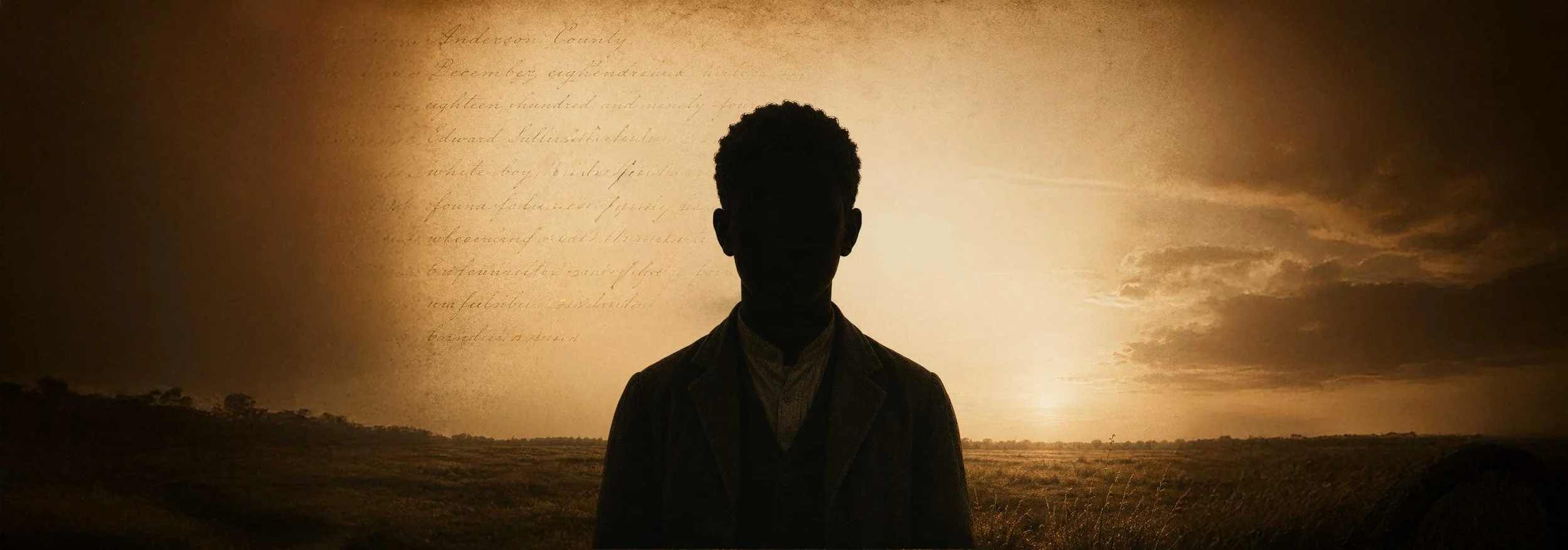
WILLIS JACKSON
Honea Path, SC
—
October 10, 1911
Age 17
TIMELINE
-
October 10, 1911 (7:30 a.m.)
An assault is reported in Honea Path.
-
October 10, 1911 (Shortly Afterward)
Willis Jackson is arrested while working as a delivery boy.
-
October 10, 1911 (9:30 a.m.)
Willis is transferred to the Anderson County Jail for protection.
-
October 10, 1911 (Noon)
An armed mob travels to Anderson but discovers Willis has already been moved.
-
October 10, 1911 (Afternoon)
Willis is transferred to Greenville and then toward Spartanburg as the mob continues the pursuit.
-
October 10, 1911 (Late Afternoon)
Officers hide with Willis in nearby woods.
-
October 10, 1911 (Evening)
The mob captures Willis after forcing the escort driver to reveal the hiding place.
-
October 10, 1911 (Approximately 11:00 p.m.)
Willis is returned to Honea Path.
-
October 10, 1911 (Approximately 11:24 p.m.)
Willis Jackson is lynched near the site of the alleged assault.
-
October 11, 1911
A coroner's jury concludes he died at the hands of an "unknown mob."
-
We Must Remember
No member of the mob is ever identified or prosecuted.
The Story
-
Willis Jackson was only seventeen years old.
He worked as a delivery boy for a local butcher shop in Honea Path, carrying meat and groceries throughout the community. Like many young people, he spent his days working, serving customers, and helping support himself.
Very little else survives about his life.
We do not know what dreams he held, what his family hoped for him, or what future he imagined. History preserved only the circumstances of his death, not the ordinary moments that made up his life.
That silence is part of the tragedy.
Willis was still a teenager when he became the target of one of the largest manhunts and one of the most widely witnessed racial terror lynchings in Anderson County's history.
Today we remember Willis Jackson not for the accusation that surrounded his death, but for the young life that was denied the opportunity to become anything more.
-
On the morning of October 10, 1911, a young white woman in Honea Path reported being assaulted by a Black man near her home. Within minutes, white residents began gathering, and law enforcement officers arrested several Black men, including seventeen-year-old Willis Jackson.
Although little evidence was publicly presented, Willis was identified by the young woman and immediately became the focus of public suspicion. Recognizing that a lynching was likely, local officers transferred him to the Anderson County Jail for his protection.
The danger did not end there.
As news spread, an armed mob organized in Honea Path under the leadership of South Carolina State Representative Joshua Ashley. The mob traveled to Anderson intending to seize Willis from the county jail.
Learning that the mob was approaching, the sheriff secretly transferred Willis to Greenville.
When the mob reached Anderson, they discovered he was gone and immediately resumed the chase.
Again, officers moved Willis—this time toward Spartanburg—in another effort to save his life.
For nearly an entire day, officers, sheriffs, and the mob raced across approximately one hundred miles of South Carolina roads. At one point, officers hid with Willis in nearby woods while waiting for help to arrive. The strategy nearly succeeded.
But after members of the mob forced the driver of the escort vehicle to reveal their hiding place, they captured Willis.
The officers surrendered him without using force.
That night, the mob carried Willis back to Honea Path.
No court ever heard his case.
-
Near midnight on October 10, 1911, the mob returned Willis Jackson to the area where the alleged assault had taken place.
Newspapers reported that Willis pleaded for his life.
Instead of bringing him before a judge or jury, the mob tied a rope around one of his feet, suspended him from a telephone pole upside down, and opened fire.
Contemporary reports estimated that approximately four hundred bullets struck his body.
His remains were left hanging through the night.
By the following morning, thousands of people had gathered to witness the aftermath. Some newspapers estimated that as many as five thousand spectators either participated in or observed the lynching. Before the coroner arrived, individuals severed several of Willis's fingers as souvenirs—a horrifying practice that reflected how racial terror lynchings often became public spectacles rather than secret crimes.
The violence extended beyond Willis's death.
Because newspapers repeatedly presumed his guilt before any trial had occurred, even members of the Black community faced painful decisions about how to respond. His mother reportedly struggled with whether to claim his body, while others feared retaliation simply for providing him a proper burial.
In the end, Willis Jackson was buried at county expense.
No one was ever convicted for taking his life.
-
Willis Jackson's story reminds us that racial terror was never simply the work of anonymous mobs. It involved elected officials, respected citizens, newspaper editors, law enforcement decisions, and communities willing to tolerate or celebrate violence carried out beyond the rule of law.
His story also reminds us of the fragility of justice. Throughout one extraordinary day, multiple officers attempted to move Willis from one jail to another in hopes of protecting him. Yet every effort failed because the legal system ultimately proved unwilling or unable to confront the mob that pursued him.
The Anderson Area Remembrance & Reconciliation Initiative remembers Willis Jackson because no accusation should ever erase a person's humanity or their constitutional right to due process. By telling his story honestly, we honor a young life that deserved the opportunity to be heard in a court of law instead of being silenced by violence.
-
Willis Jackson's story is unlike any other documented racial terror lynching in Anderson County.
For nearly sixteen hours on October 10, 1911, law enforcement officers attempted to stay one step ahead of an armed white mob determined to kill a seventeen-year-old Black boy before he could stand trial.
The pursuit stretched across nearly one hundred miles of South Carolina roads, weaving through Honea Path, Anderson, Greenville, and toward Spartanburg. At every turn, officers sought another place of safety. At every turn, the mob followed.
This was not a spontaneous act of violence.
It was a coordinated pursuit involving hundreds of armed men traveling by automobile, trolley, train, and horseback. The chase was led by Joshua Ashley, a sitting member of the South Carolina House of Representatives, whose leadership illustrates how racial terror often drew support from individuals holding positions of public trust.
As you explore the map below, follow the route that Willis Jackson traveled on the final day of his life.
Honea Path
The morning began with an accusation. Within minutes, Willis Jackson was arrested while working as a delivery boy. As word spread through the community, a white mob quickly formed and demanded vengeance before any investigation or trial could take place.
Anderson
Recognizing the danger, local officers transferred Willis to the Anderson County Jail. But by midday, more than one hundred armed men had arrived in the city, intent on storming the jail. Learning that Willis had already been moved, the mob immediately resumed its pursuit.
Greenville
The transfer to Greenville offered only temporary hope. Fearing the mob would reach the jail, officers continued without stopping, choosing to move Willis once again rather than risk another confrontation.
The Woods Between Greenville and Spartanburg
With muddy roads slowing their progress, officers abandoned their vehicle and hid with Willis in a wooded area while waiting for reinforcements. For a brief moment, it appeared they had escaped.
That hope ended when members of the mob cornered the young driver of the escort vehicle, forced him to reveal the hiding place, and descended upon the officers.
Willis Jackson was taken into the custody of the mob.
Return to Honea Path
Rather than delivering him to a courtroom, the mob carried Willis back to Honea Path. Near midnight, they tied him upside down from a telephone pole and opened fire. Newspapers estimated that approximately four hundred shots were fired before the crowd dispersed, leaving his body hanging through the night.
The route shown on this map represents more than a journey across South Carolina.
It reveals the extraordinary lengths taken to preserve one young man's life—and the equally determined efforts of a mob committed to denying him the protections guaranteed by law.
Willis Jackson never received his day in court.
His story reminds us that justice is not measured only by the existence of laws, but by a community's willingness to uphold them.
Artifacts
-
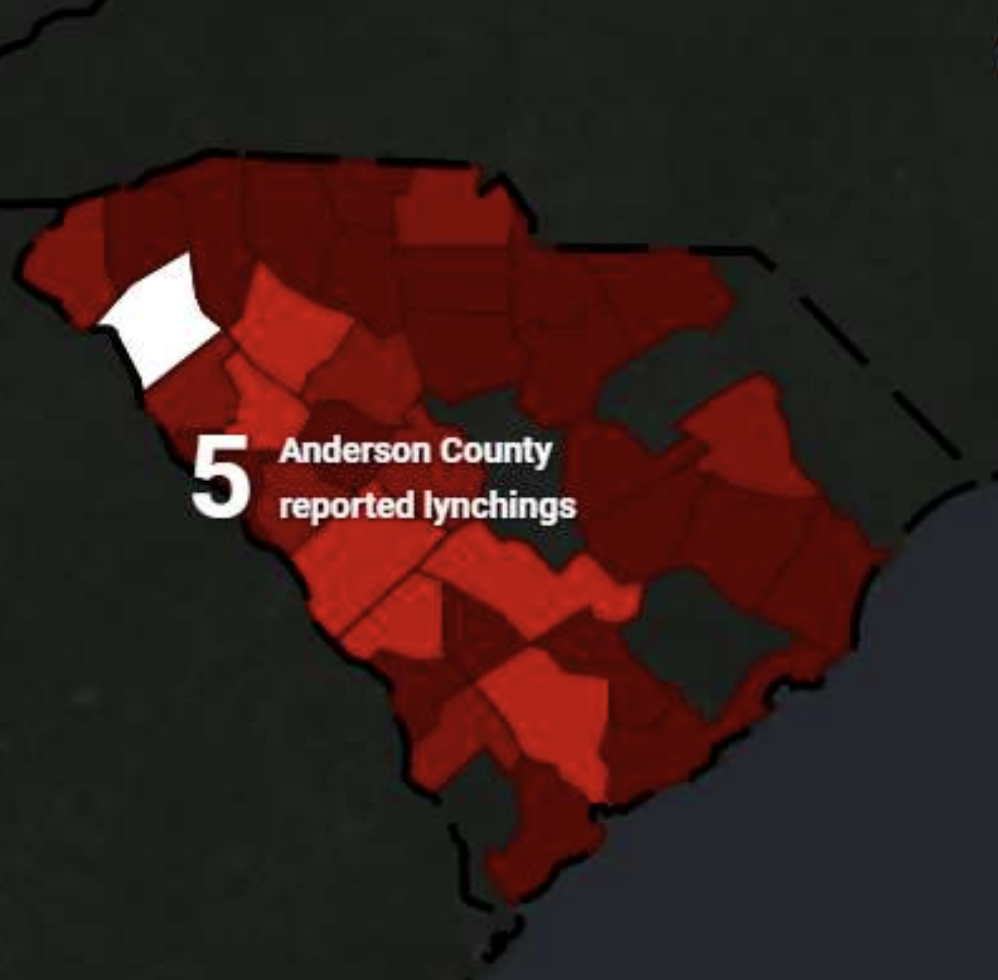
EJI Document
-
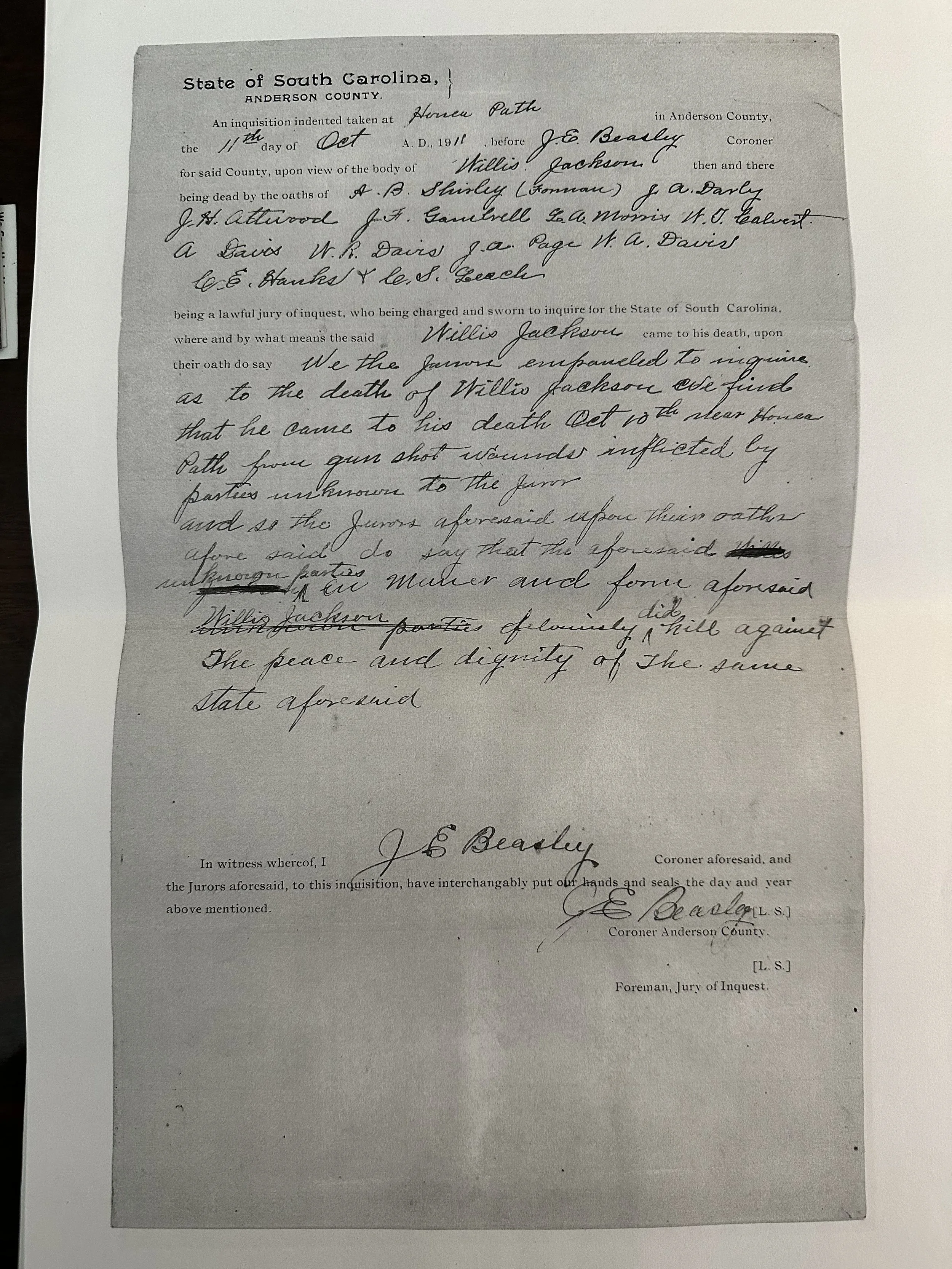
Willis Jackson Coroner's Inquest - October 11, 1911
-
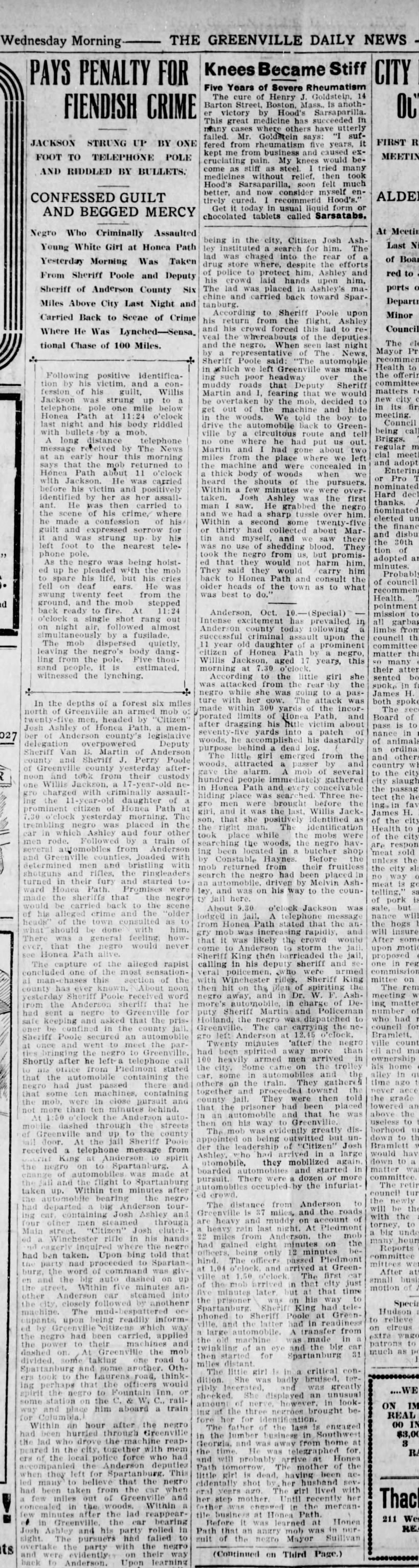
Greenville Daily News - October 11, 1911
-
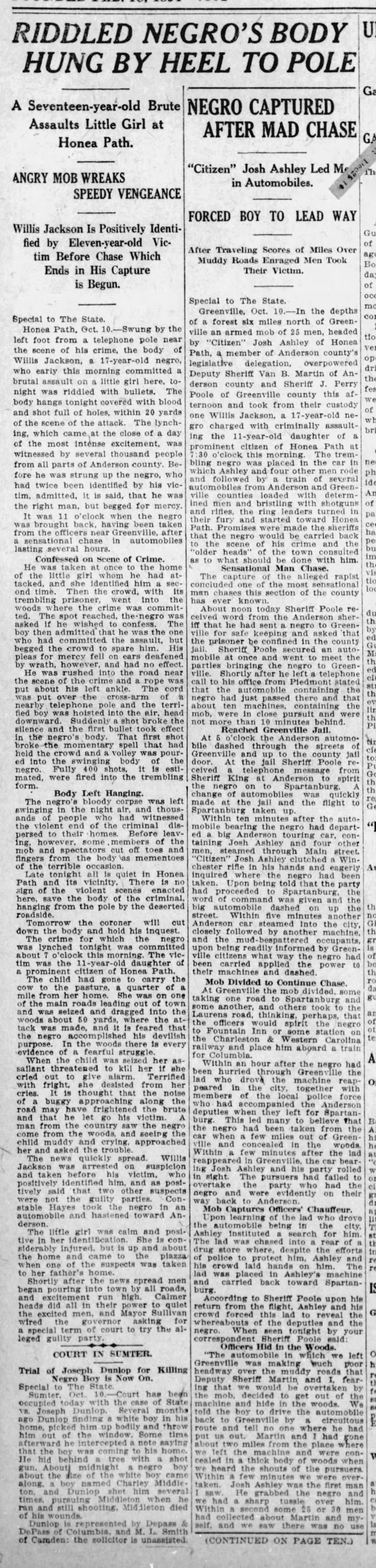
The State Newspaper (Columbia, SC) - October 11, 1911
-
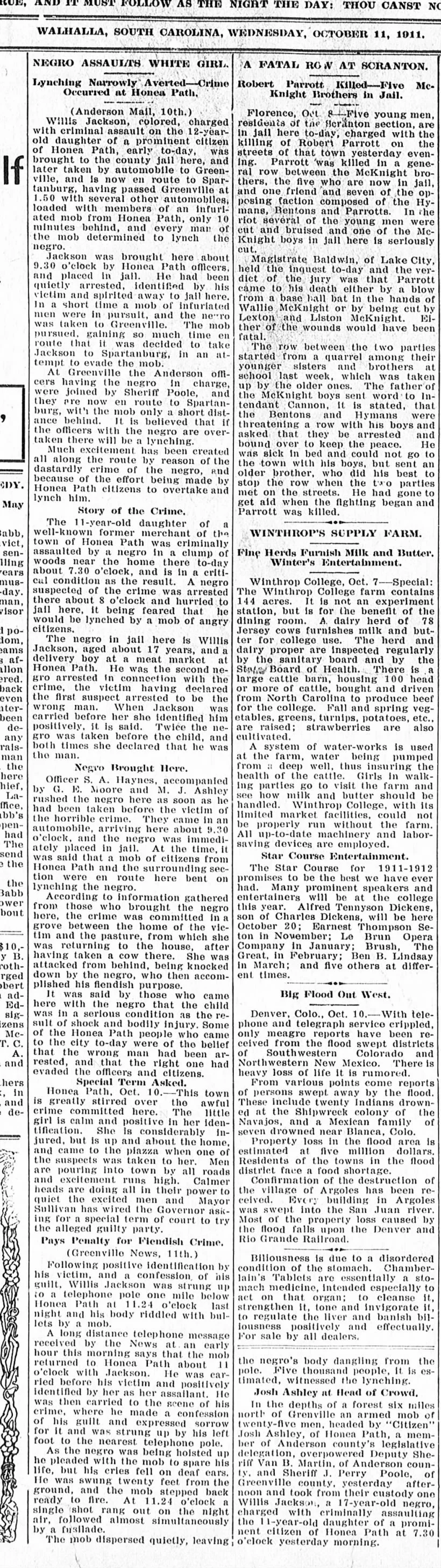
Keowee Courier (Pickens, SC) - October 11, 1911
-
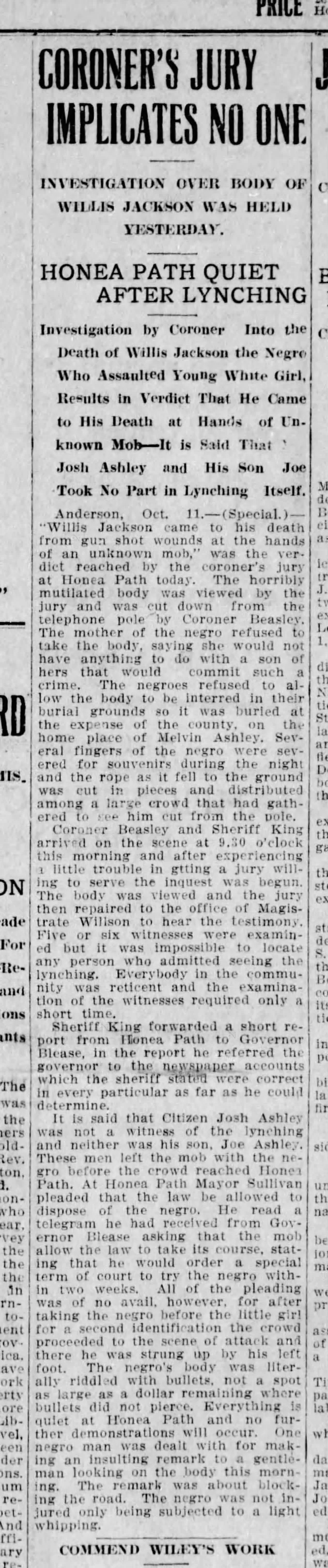
Greenville Daily News - October 12, 1911
-
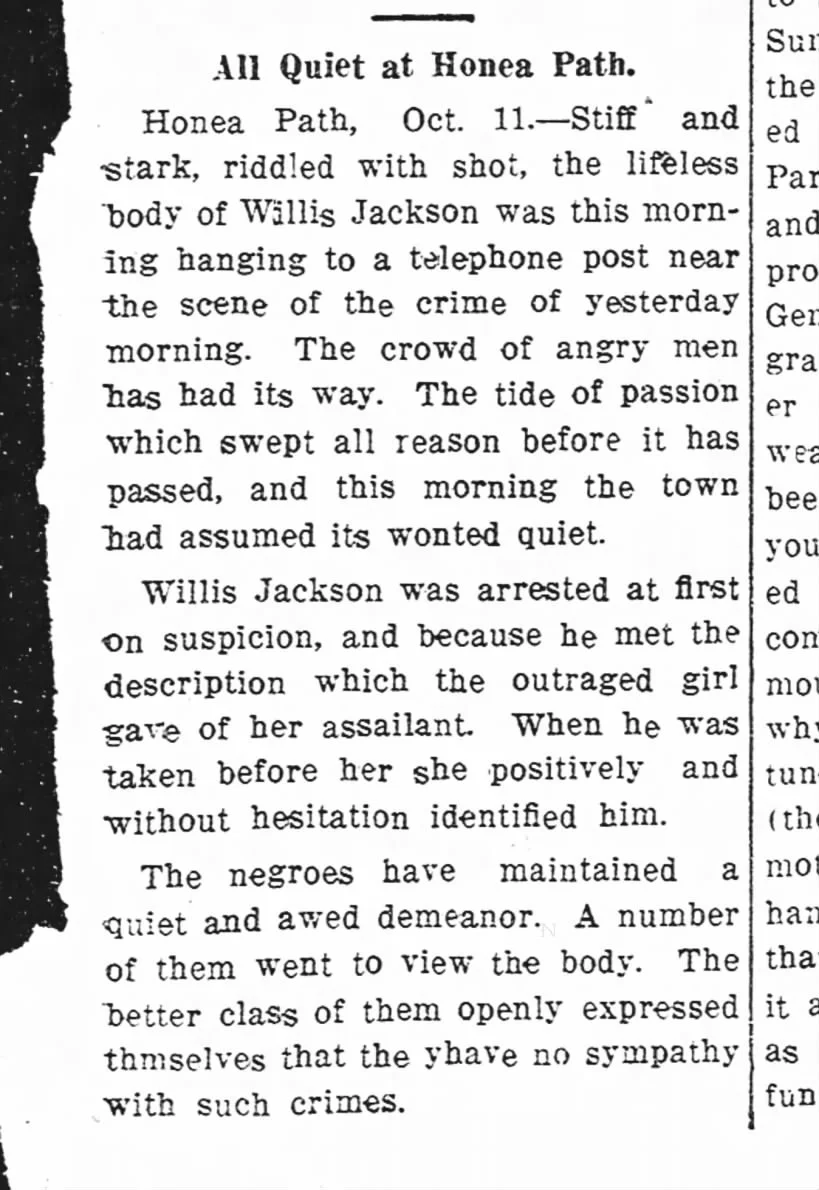
Newberry Weekly Herald - October 13, 1911
-
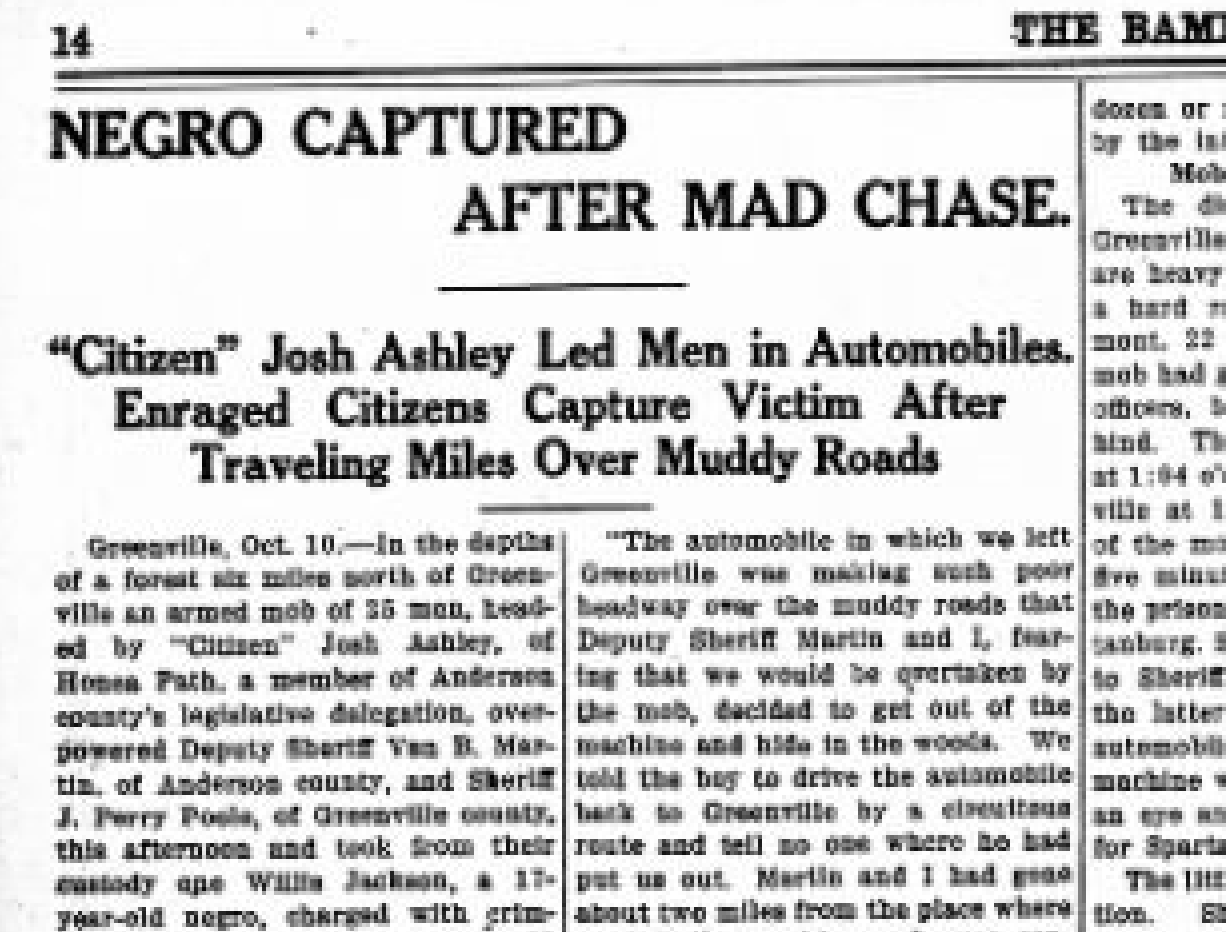
Bamberg Herald - October 19, 1911
-
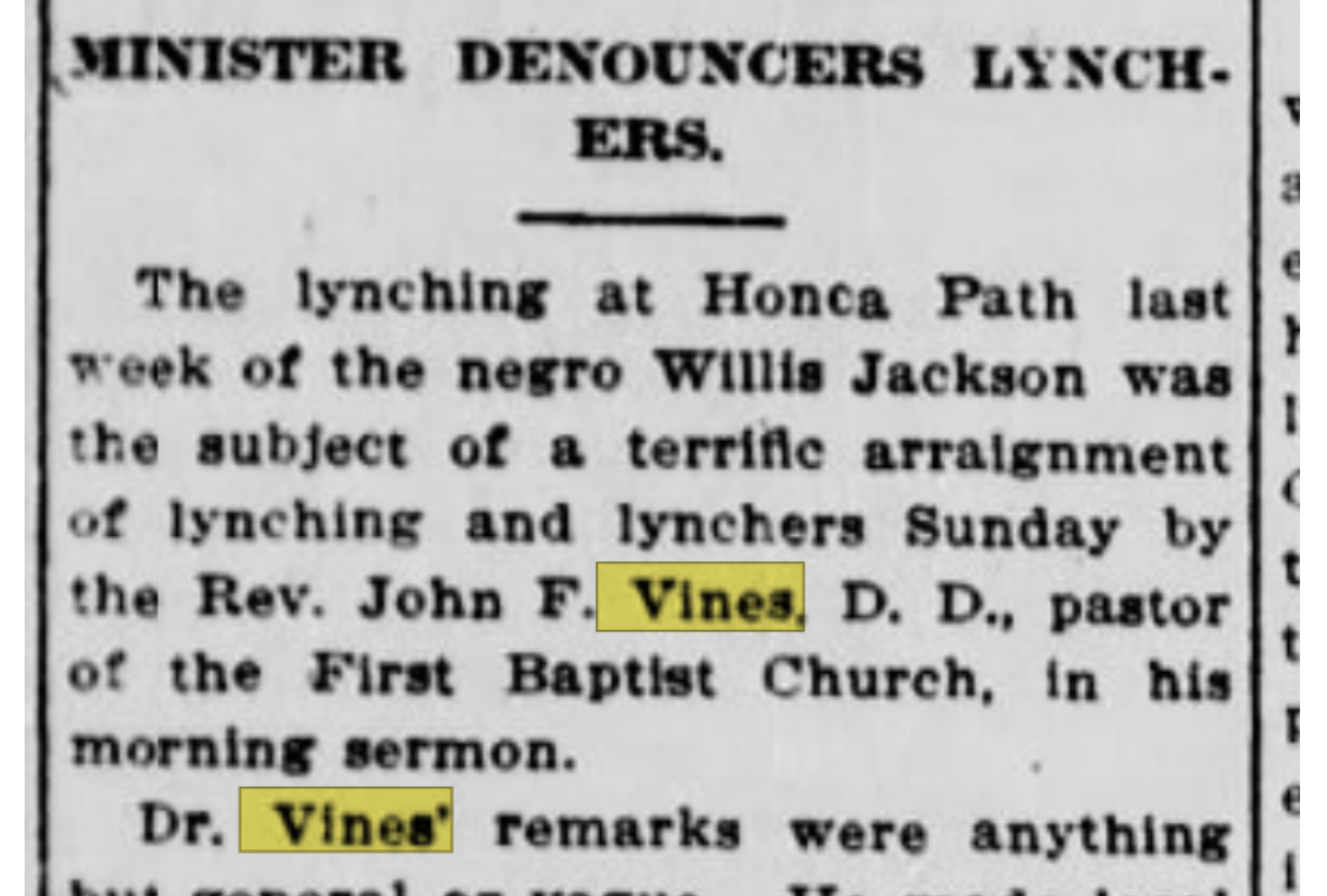
Sumter News - October 1911 (Dr. Vines Sermon)
Remembrance: Willis Jackson Documentary Storytelling Journey
This story was produced by Anderson University's COM 451 Documentary Storytelling Team in Spring 2024.
Anderson University's COM 451 Documentary Storytelling Team
Emma Bechtold - Producer / Writer
Charlie Lynch - Producer / Writer
Makenna Massey - Producer / Writer
Avery Torok - Director / Videographer / Editor
Daniel Wright - Producer / Writer / Editor
Special thanks to:
Dr. Josh Phillips
Dr. Otis Pickett
Dr. Lindsay Privette
Dr. Stuart Sprague
Aaron Ducksworth
Faculty Member / Executive Producer:
Bobby Rettew, MA / COM 451 Instructor
Assistant Professor
Anderson University
Department of Communication
Dr. John F. Vines: A Courageous Voice in 1911
In the days following the lynching of 17-year-old Willis Jackson, much of the white press in South Carolina either justified the mob's actions or presumed Willis Jackson's guilt without the benefit of due process. Against that backdrop, one local voice stood apart.
Dr. John F. Vines, pastor of First Baptist Church in Anderson from 1908 to 1915, delivered one of the most courageous public responses to the lynching. In a sermon that generated significant attention throughout the community, Vines condemned both the violence of the mob and the moral failure of those who tolerated or celebrated it.
Drawing from Christian convictions and the rule of law, Vines challenged the very people who claimed to be defending virtue. As reported by The Watchman and Southron of Sumter, he declared:
"The people who mainly compose lynching mobs talk much of defending virtue, but are not themselves distinguished for virtue."
Vines also spoke directly about the role of South Carolina State Representative Joshua Whitner Ashley, whose leadership in the pursuit and capture of Willis Jackson had become widely known. At a time when many influential citizens remained silent, Vines publicly criticized Ashley's actions and called upon both civic and religious leaders to reject mob violence.
His sermon was not delivered in hindsight. It came at a moment when speaking against lynching required extraordinary moral courage.
In addition to serving as pastor of First Baptist Church, Dr. Vines later served as president of Anderson College from 1913 to 1914. He was widely recognized as a gifted preacher, educator, and revival speaker whose influence extended well beyond Anderson County.
Today, his sermon stands as an important reminder that even during one of the darkest chapters of Anderson's history, there were individuals willing to speak difficult truths, defend the rule of law, and insist that justice could never be achieved through mob violence.
This story was produced by Anderson University's COM 451 Documentary Storytelling Team in Spring 2024.
Anderson University's COM 451 Documentary Storytelling Team
Joshua Acree: Producer/Editor
Talon Bolme: Producer
Zoe Dubiski-Pitts: Producer
Samuel Nadal: Videographer/Editor
Special thanks to:
Anderson University Library & Special Archives
First Baptist Church of Anderson, SC
Dr. Lindsay Privette, Associate Professor, Anderson University
Dr. Stuart Sprague, Professor Emeritus, Anderson University
Dr. Joyce Wood, Professor Emeritus, Anderson University
al: Videographer/Editor
Faculty Member / Executive Producer:
Bobby Rettew, MA / COM 451 Instructor
Assistant Professor
Anderson University
Department of Communication
"The end is reconciliation; the end is redemption; the end is the creation of the Beloved Community."
— Dr. Martin Luther King, Jr.