

ELBERT HARRIS
Anderson County, SC (Near Iva)
—
May 20, 1898
Age 18
TIMELINE
-
Circa 1880
Elbert Harris is born near Iva, South Carolina.
-
May 19, 1898
A ginhouse burns near Iva; suspicion falls on the Harris family.
-
May 20, 1898
Elbert, his father Asbury, and his uncle Joseph are arrested.
-
May 20, 1898
While being transported to Anderson, a mob abducts Elbert from police custody.
-
May 20, 1898
Elbert is brutally whipped and beaten, then returned to the constable.
-
May 20–25, 1898
Elbert remains critically injured in the Anderson County Jail.
-
May 25, 1898
Elbert Harris dies from injuries sustained in the attack.
-
1898–1901
His family file multiple lawsuits against Anderson County, but no jury holds the county responsible.
-
We Must Remember
No member of the mob is ever prosecuted.
The Story
-
Elbert Harris was eighteen years old when he was brutally beaten by a white mob outside Anderson, South Carolina, in May 1898.
He lived with his family near Iva, where his father, Asbury Harris, worked as a farm laborer and his mother, Philis Harris, cared for their home and children. Like many African American families in the rural South during the late nineteenth century, the Harrises worked hard to build a life despite the daily realities of segregation, discrimination, and the constant threat of racial violence.
Much about Elbert's personal life has been lost to history. We do not know what he hoped to become or what dreams he carried into adulthood. What survives is the story of a young man whose life mattered, whose family loved him, and whose death exposed the failure of a legal system that refused to protect Black lives.
Today we remember Elbert Harris not because of the accusations made against him, but because he was denied the opportunity every person deserves—the chance to stand before the law as innocent until proven guilty.
-
In May 1898, several acts of property destruction were reported around the railroad community of Iva, including the burning of a local ginhouse. Suspicion quickly fell upon the Harris family, despite little evidence connecting them to the crime.
Law enforcement officers searched the Harris home and claimed to have found railroad tickets and firearms that they believed linked the family to criminal activity. Based on those allegations, Elbert Harris, his father Asbury Harris, and his uncle Joseph Harris were arrested and placed in custody on May 20, 1898.
Following a preliminary hearing, a specially appointed constable began transporting the three men approximately sixteen miles to the Anderson County Jail.
Just a few miles into the journey, a mob of about twenty white men stopped the escort and demanded Elbert Harris. According to contemporary reports, the mob instructed the constable to wait while they took him away. The officer made no attempt to resist.
The mob brutally whipped and beat Elbert before abandoning him beside the road.
When the constable eventually recovered him, Elbert was critically injured but was taken to the Anderson County Jail rather than a hospital. A physician later documented severe injuries across his back and legs, but despite medical attention, Elbert remained imprisoned while suffering from the injuries inflicted by the mob.
On the morning of May 25, 1898, four days after the attack, Elbert Harris died in his jail cell.
No member of the mob was ever identified or prosecuted.
-
Elbert Harris's death did not end with the lynching.
His parents refused to allow his life to be forgotten.
Although a coroner's jury acknowledged that Elbert died from wounds inflicted by unknown individuals, no meaningful criminal investigation followed. The men responsible were never brought to justice.
Instead, Elbert's parents turned to the courts.
Using a provision in South Carolina's 1895 Constitution that allowed families of lynching victims to seek damages from counties that failed to protect prisoners in their custody, Philis Harris filed suit against Anderson County seeking $10,000 in damages. Her case ended without justice. Elbert's father, Asbury Harris, later filed his own lawsuit, resulting in two separate trials. Both concluded in mistrials, leaving the Harris family without accountability or compensation.
Meanwhile, the criminal accusations that had been used to justify suspicion against the Harris family steadily collapsed. Charges against Joseph Harris were dismissed, and Asbury Harris's conviction was later overturned.
For the Harris family, however, these legal victories came too late. Elbert had already lost his life.
Their persistence stands as a remarkable act of courage. At a time when many Black families had little reason to believe the legal system would protect them, Philis and Asbury Harris insisted that their son's life had value and that those entrusted with protecting him should be held responsible for their failure.
-
Elbert Harris's story reminds us that racial terror was not only carried out by mobs. It was sustained by institutions that failed to protect those in their custody, investigate acts of violence, or hold perpetrators accountable.
His story also reveals something equally important: the extraordinary courage of families who continued to seek justice even when the legal system repeatedly denied it.
The Anderson Area Remembrance & Reconciliation Initiative believes remembrance is more than preserving history. It is restoring dignity to lives that were diminished by injustice and honoring those who refused to stop pursuing truth.
Remembering Elbert Harris means remembering both the violence that took his life and the resilience of a family that insisted his life mattered.
Artifacts
-
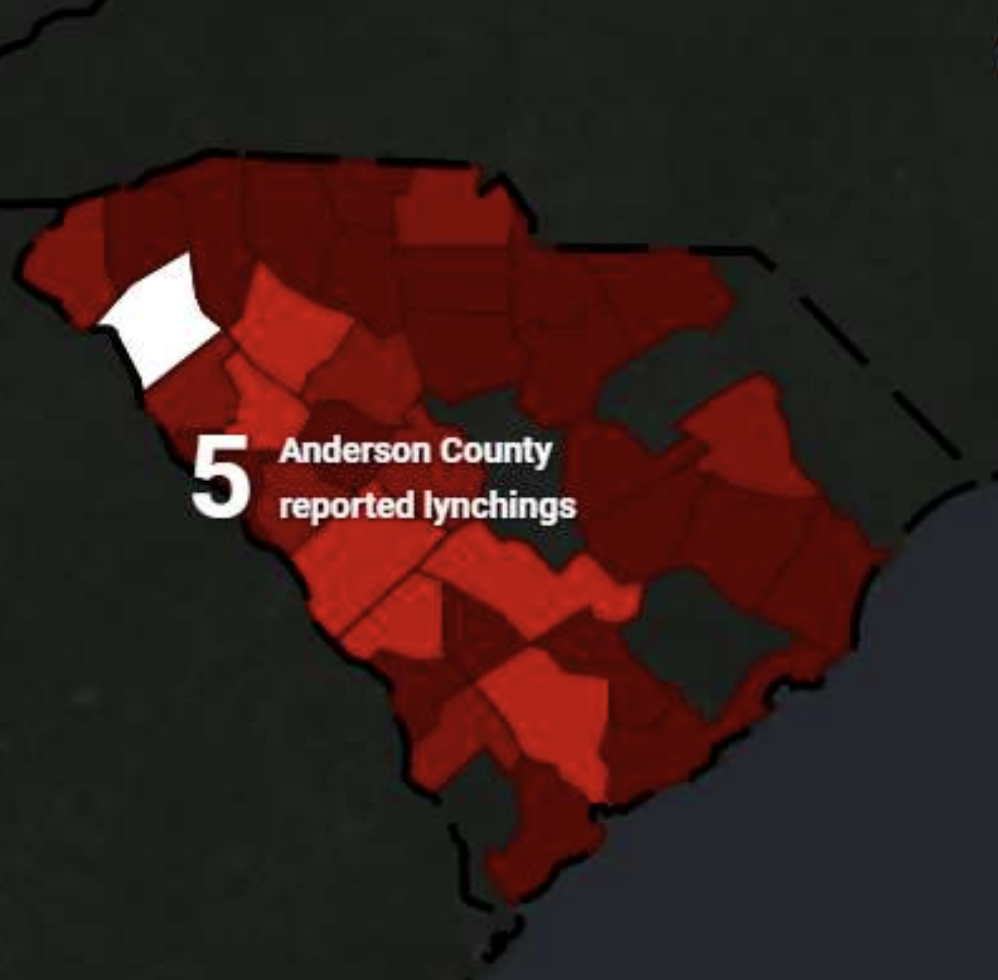
EJI Document
-
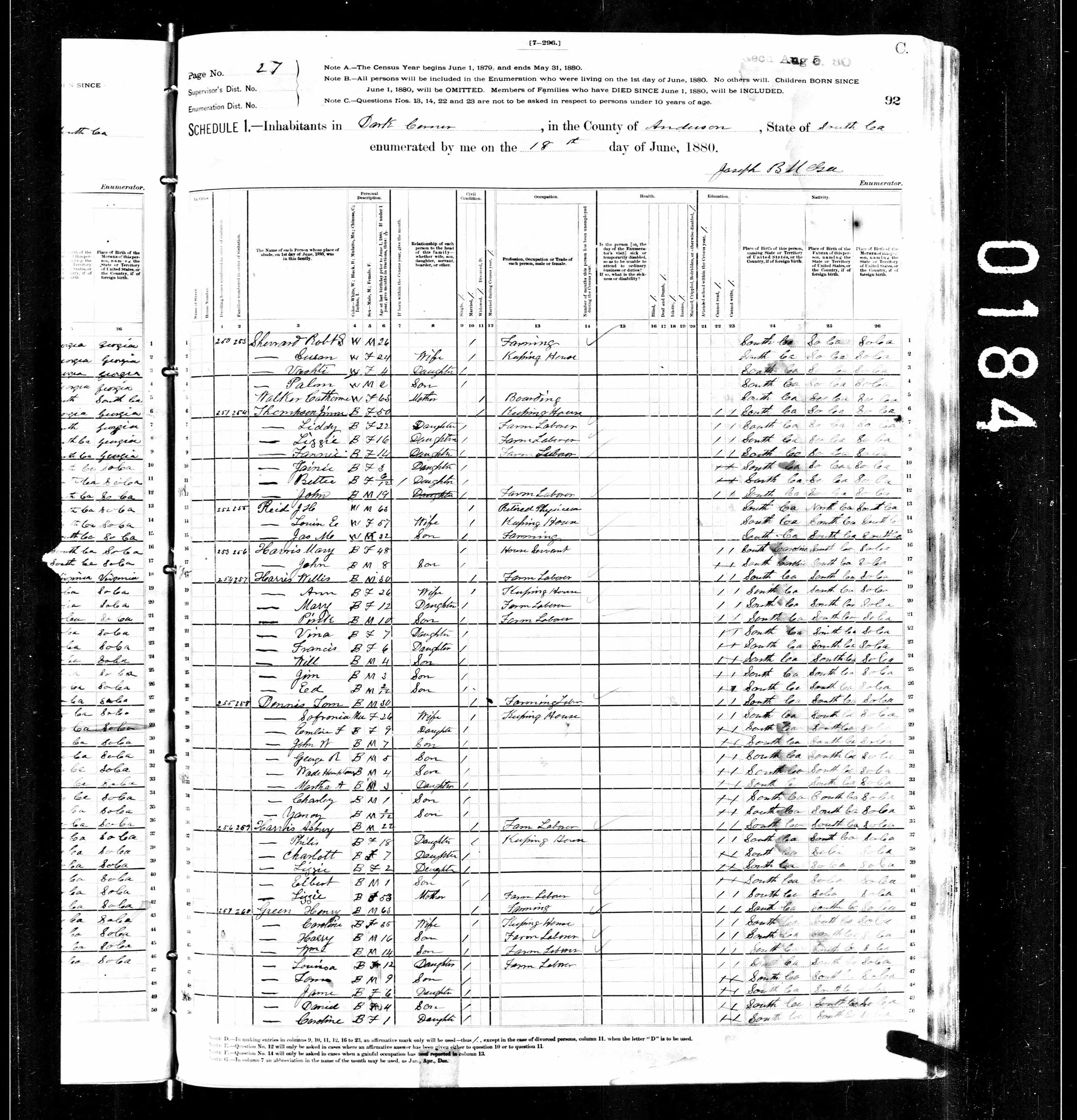
US Census Records - June 18, 1880
-
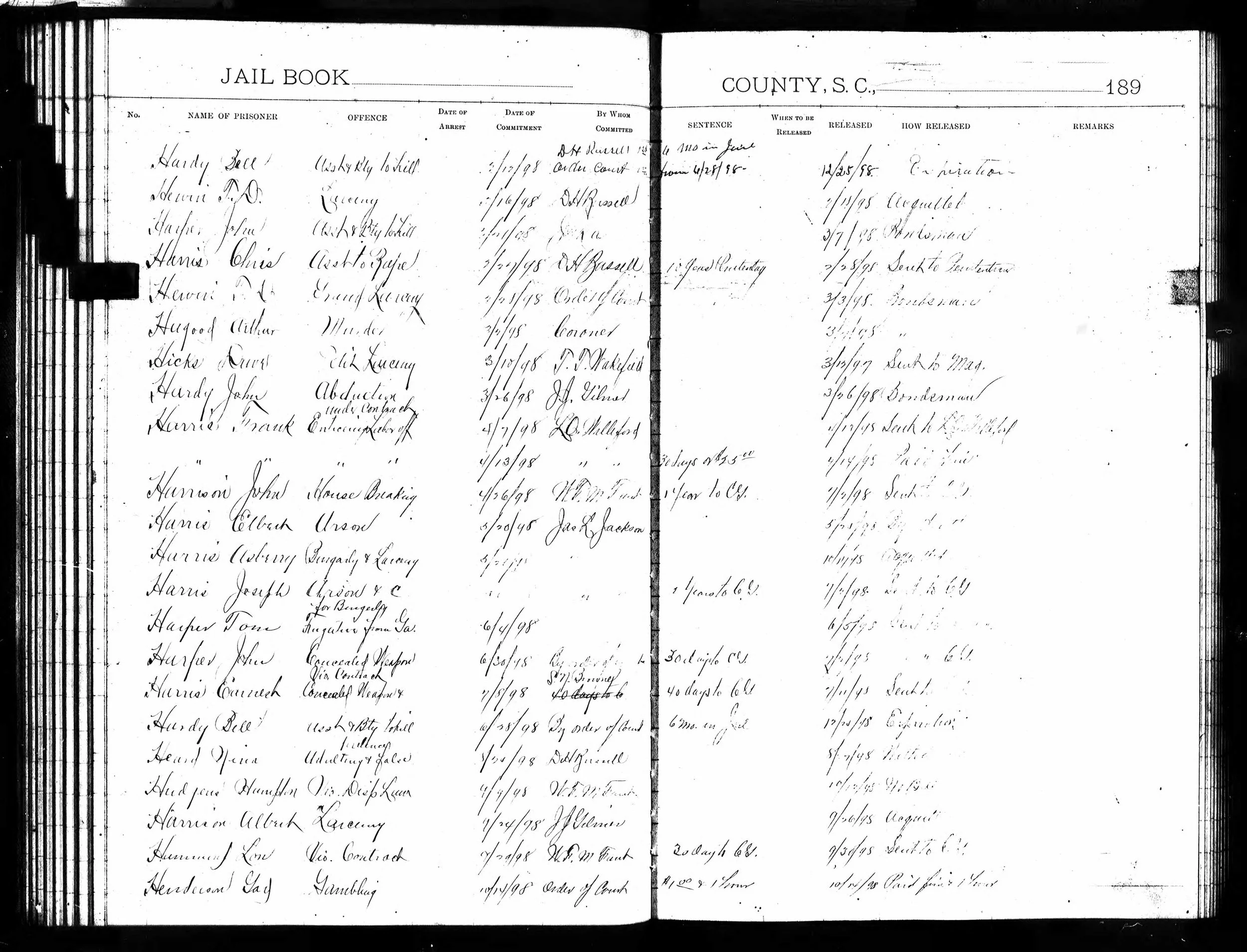
Elbert Harris Jail Records - May 20, 1898
-
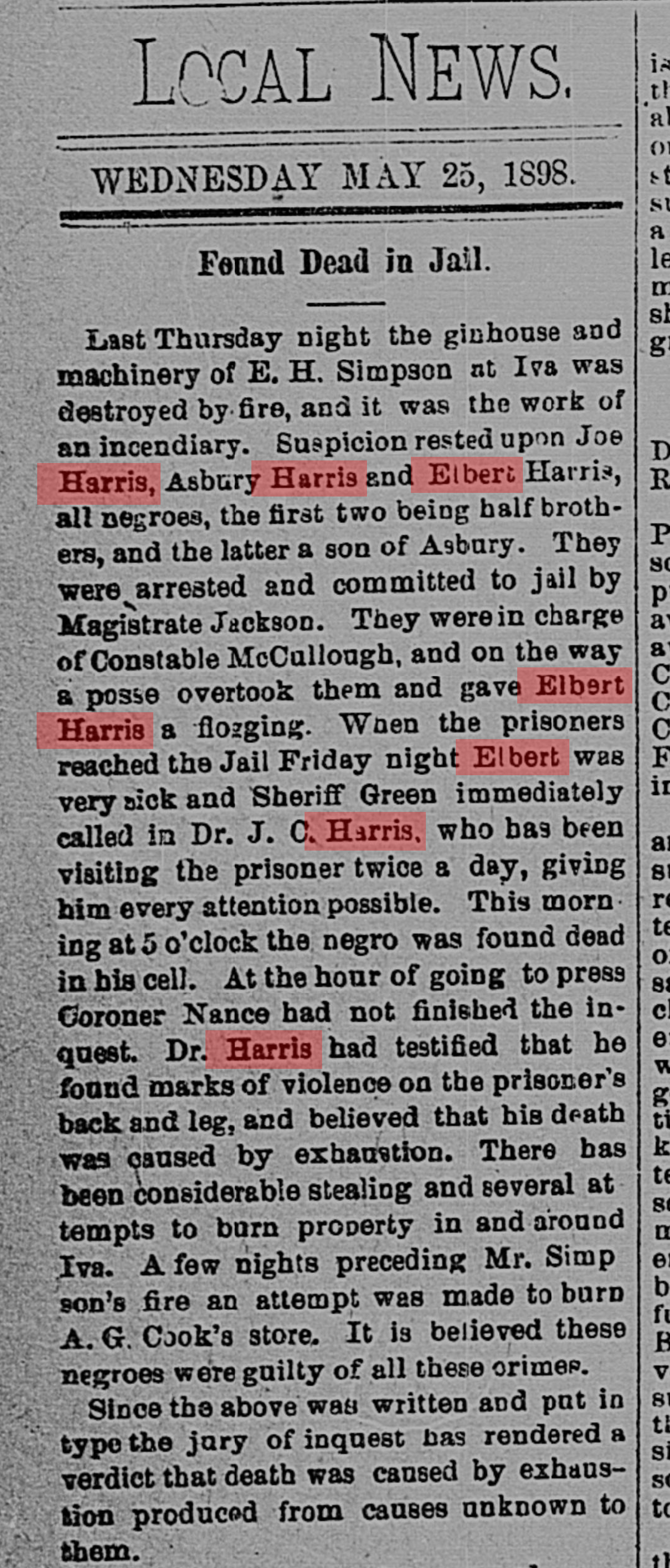
Anderson Intelligencer - May 25, 1898
-
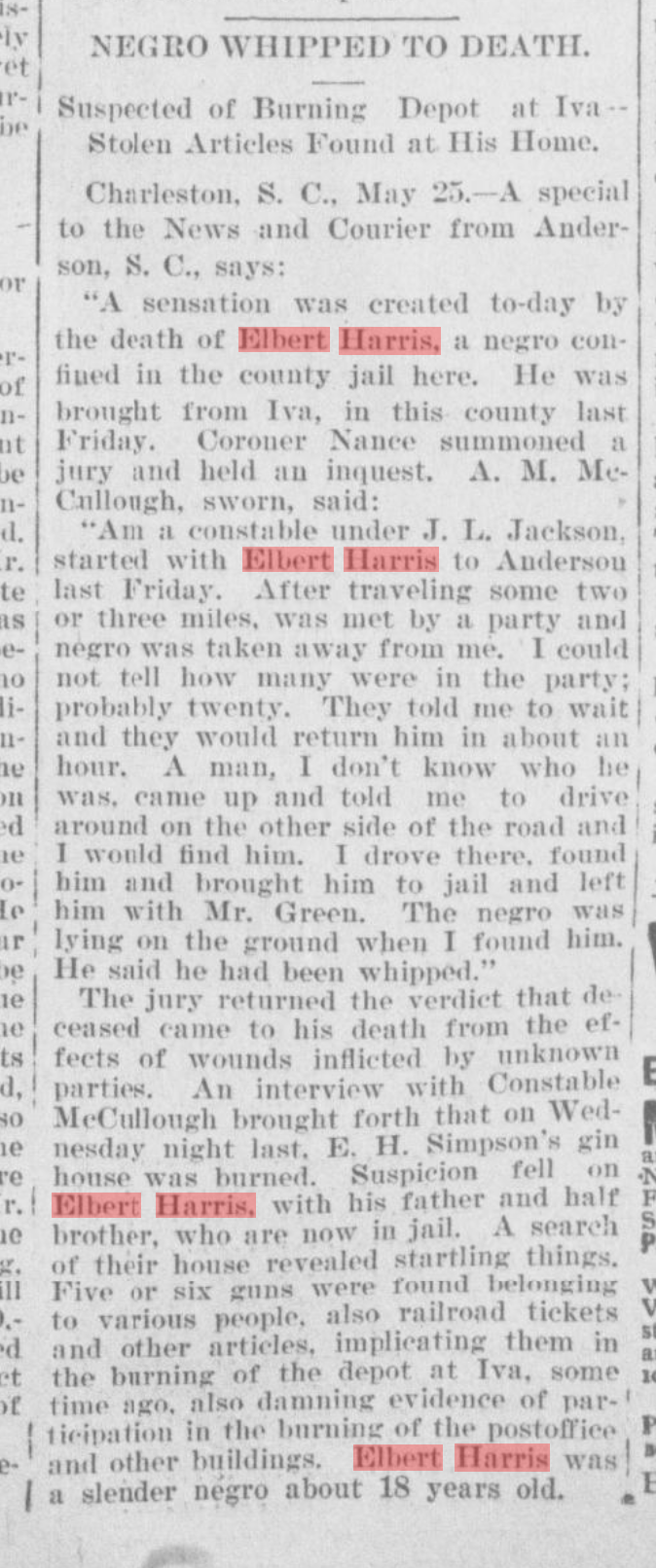
News and Observer (Raleigh, NC) - May 26, 1898
-
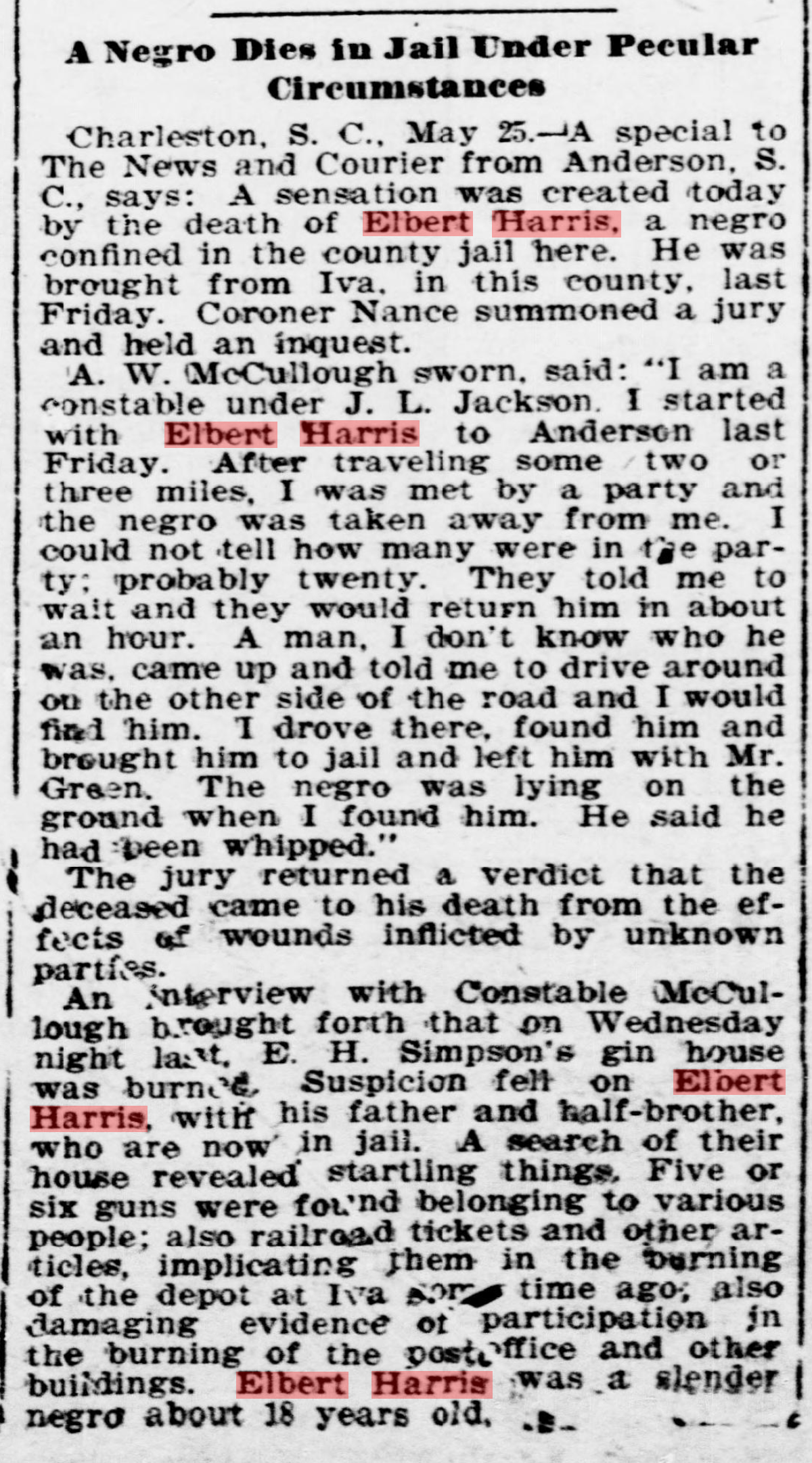
The Semi-Weekly Messenger (Wilmington, NC) - May 27, 1898
-

Anderson Intelligencer - July 6, 1898 (No One Charged)
-
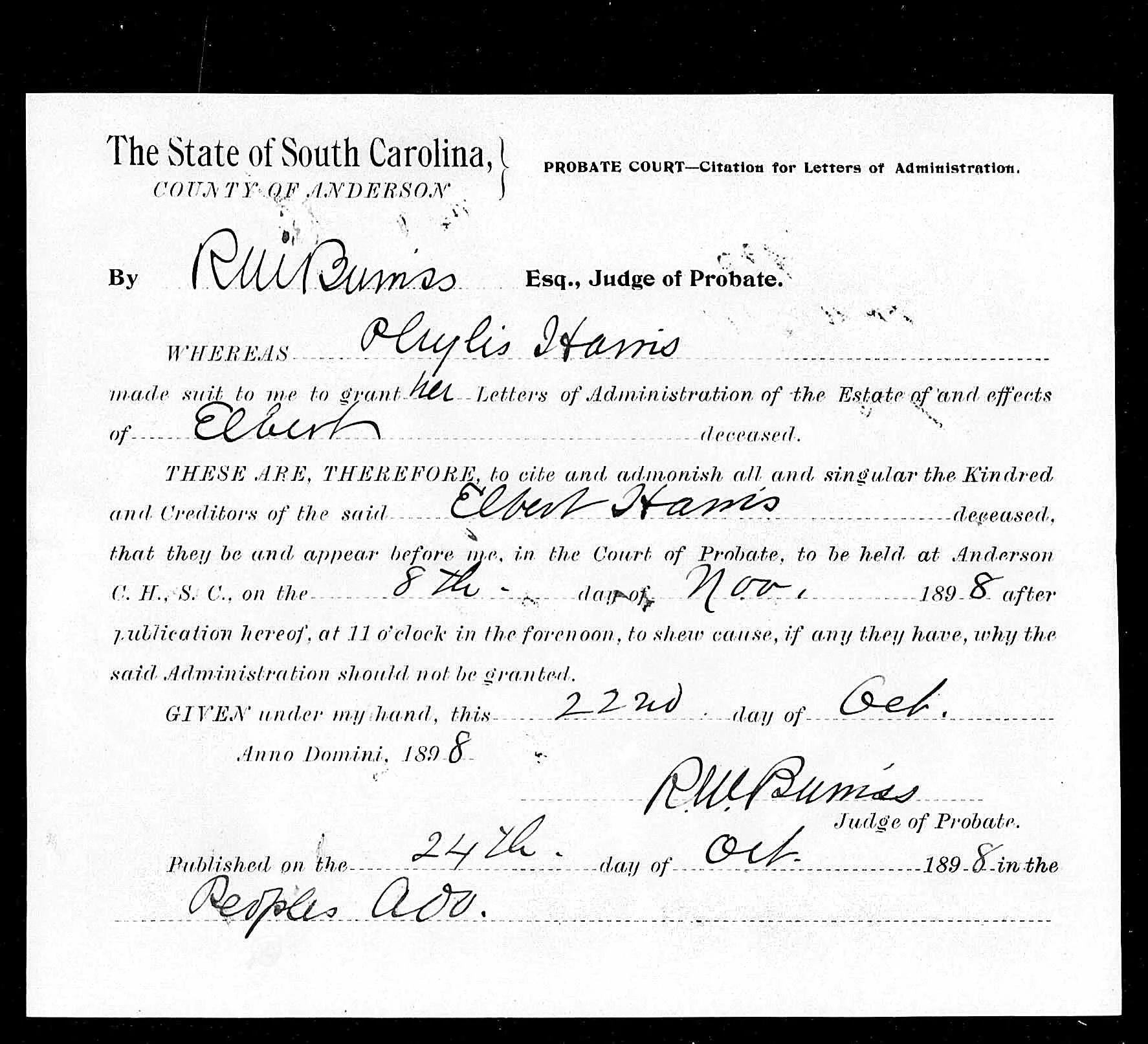
Probate Court Documents - November 8, 1898
-
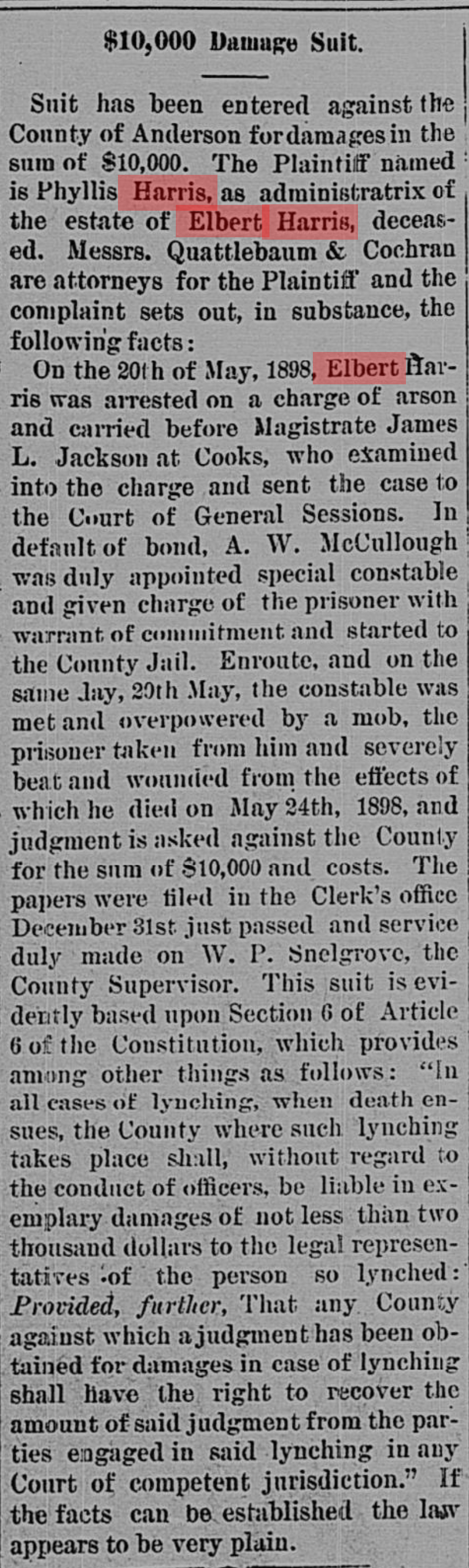
Anderson Intelligencer - January 4, 1899 (Lawsuit)
-
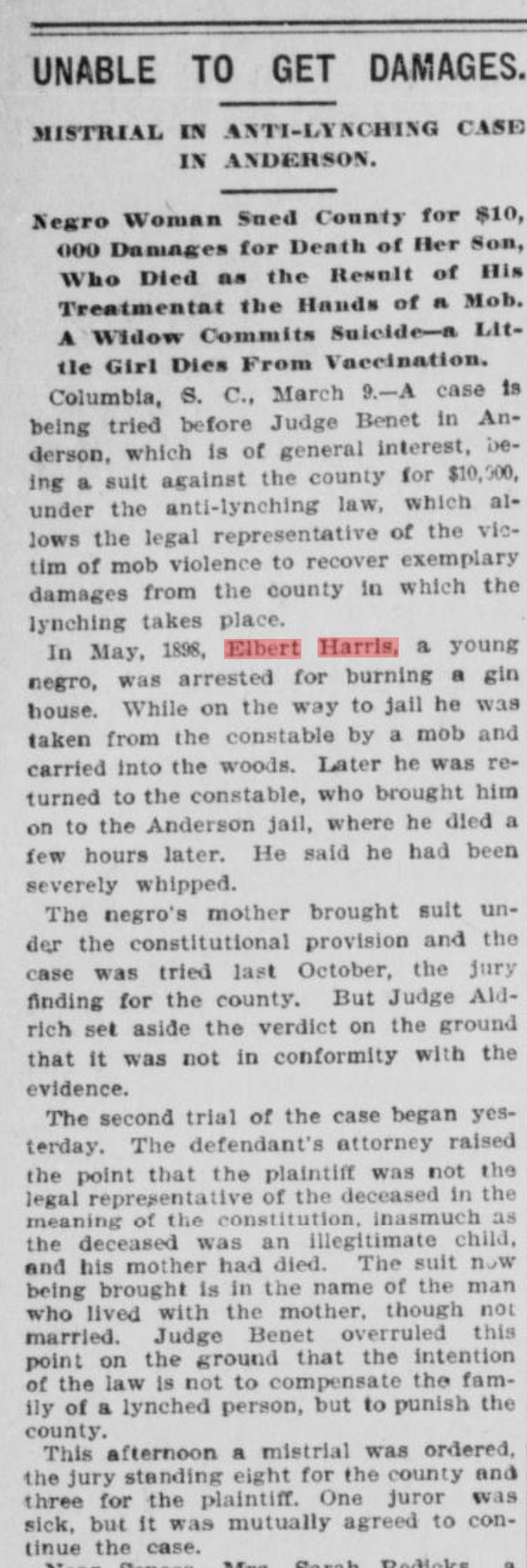
Savannah Morning News - March 10, 1901 (Anti-Lynching Lawsuit / Mistrial)
Remembrance: Elbert Harris Documentary Storytelling Journey
This story was produced by Anderson University's COM 451 Documentary Storytelling Team in Fall 2024.
Anderson University's COM 451 Documentary Storytelling Team
Dylan Johnson - Videographer and Editor
Alana Eakle - Voiceover and Researcher
Jada Patton - Producer and Scriptwriter
Special thanks to:
Tim Taylor, Clerk: Town of Iva
Dr. Stuart Sprague
Christina Griswold
Faculty Member / Executive Producer:.
Bobby Rettew, MA / COM 451 Instructor
Assistant Professor
Anderson University
Department of Communication
"The end is reconciliation; the end is redemption; the end is the creation of the Beloved Community."
— Dr. Martin Luther King, Jr.